Click to Sign Was a Good Idea. Until It Wasn't
2026-04-18
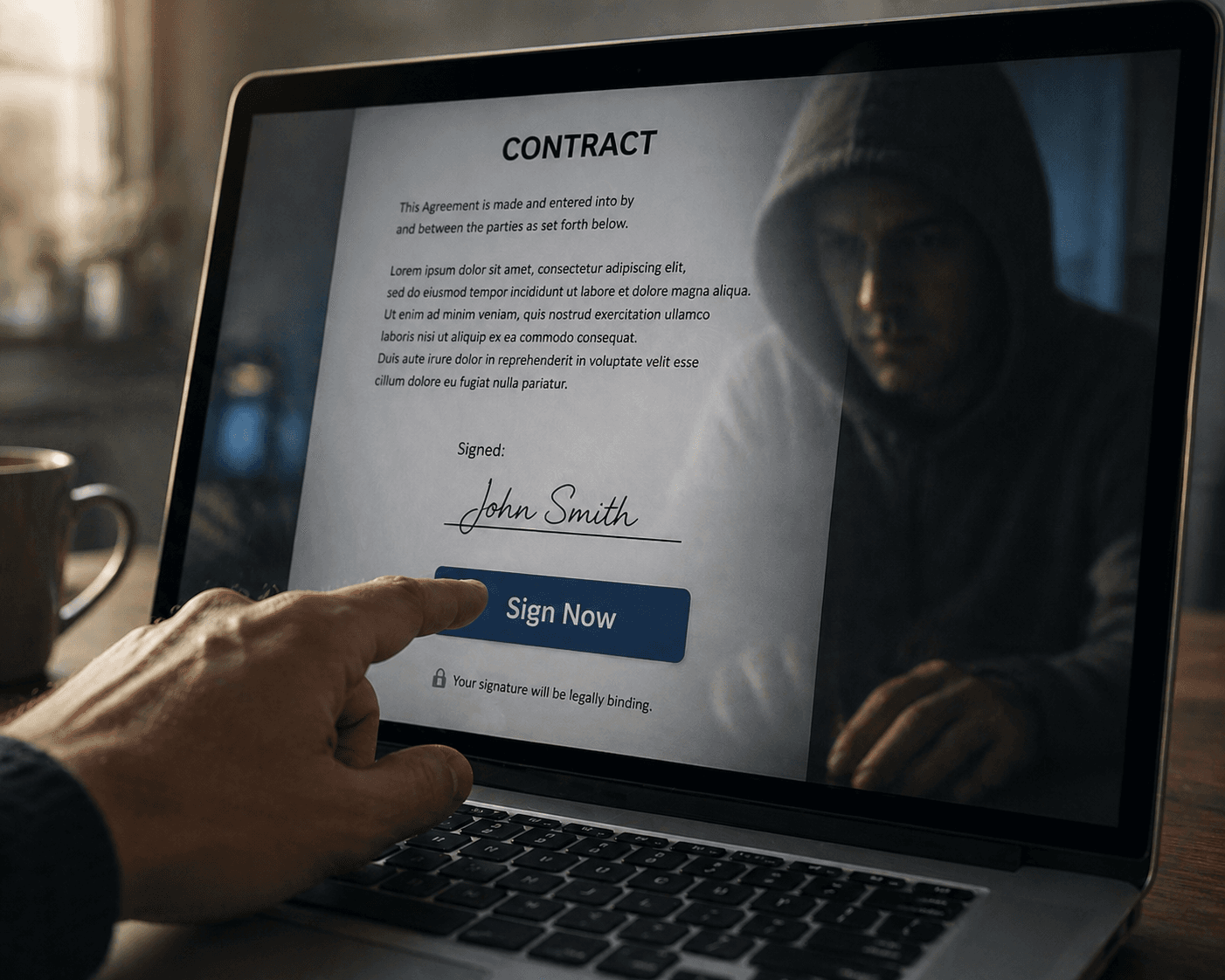
Once upon a time, an email address was a person. Or near enough. It arrived in your inbox with a name attached, perhaps even a signature at the bottom, and you felt reassured. There was a sender. There was an intention. There was, in short, a human being at the other end of the exchange, tapping away at a keyboard, perhaps pausing for tea.
Then we discovered that we could sign documents the same way. Click here. Type your name. Confirm. Efficient, painless, and a great improvement over chasing people down with paper and pens. We congratulated ourselves. We saved time. We reduced friction. We advanced.
And why not. It was a good idea.
But good ideas, like well-behaved children, have a habit of growing up into something slightly more complicated than originally intended.
The assumption beneath click to sign was simple enough. The person with access to the email is the person who should be signing. The click represents intent. The timestamp records the moment. Everything is neatly arranged. Everyone goes home satisfied.
For a while, this worked. The world did not collapse. Contracts were signed. Deals were made. Life continued, more or less as before, only faster.
Then the ground shifted, though not with a dramatic rumble. It shifted quietly, as these things tend to do. Artificial intelligence arrived, not as a single invention but as a series of increasingly persuasive imitations. Voices could be cloned. Faces could be recreated. Writing styles could be borrowed, sometimes with alarming enthusiasm.
One begins to notice that the link between identity and action has become somewhat... elastic.
If an email can be imitated, who is the sender? If a voice can be replicated, who is speaking? If a face can be generated, who is present?
These questions were once the province of philosophers and science fiction. They are now, inconveniently, practical.
And so we return to our efficient system. Click here. Type your name. Confirm. The mechanics remain unchanged. The assumptions, however, have started to fray.
You receive a document. You click. Or someone clicks. It is a small motion, barely worth noting. The system records it dutifully. A timestamp appears. An IP address is logged. A tidy record is created, as neat as a freshly made bed.
But who clicked?
It might have been you. One hopes so. It might have been someone with access to your email, which is not quite the same thing. It might have been a machine trained to imitate your habits, your language, your timing. It might have been the cat, though cats are notoriously uninterested in contractual obligations. Or so we believe.
The difficulty is not that the system fails to record the action. It records it perfectly well. The difficulty is that it records the action without reliably capturing the actor.
We have, in effect, built a system that is excellent at remembering that something happened, but less certain about who made it happen and why.
This matters more than it once did. In a quieter technological age, impersonation required effort. It involved disguises, forged documents, a certain theatrical flair. Now it can be achieved with a few lines of code and a sufficiently patient operator. The scale has changed. The speed has changed. The margin for error has narrowed.
It is worth considering what happens when a contract is challenged. Not in theory, but in practice. A dispute arises. A question is asked. Who signed this document? Did they intend to sign it? Can this be demonstrated?
The answer "a link was clicked" begins to sound less reassuring under such circumstances.
Courts, for their part, are not opposed to progress. They are not nostalgic for quill pens and sealing wax. What they require is evidence. Something that connects the action to a person and the person to an intention. Something that can withstand scrutiny, rather than simply exist as a record.
A click is a record. It is not necessarily proof.
So where does this leave us? We could persist as we are, trusting that the system will hold together through sheer habit. This is always an option, though not always a wise one. We could retreat entirely to older methods, which have their own vulnerabilities and inconveniences. Or we could acknowledge that the environment has changed and that our tools must change with it.
A signature, if it is to mean anything, must be tied to a human being in a way that is difficult to imitate and easy to demonstrate. It must capture not only the fact that an action occurred, but that a person was present, engaged, and acting with intent.
This may require more than a click. It may involve verification. It may involve observation. It may involve creating a record that looks less like a log and more like a piece of evidence.
It is a small shift in process. It is a larger shift in thinking.
Click to sign was a good idea. It solved the problems we had at the time. It made things easier. It made things faster. It did exactly what we asked it to do.
We are now asking different questions.
And it would be prudent to have better answers.